
Download PDF Programming the Microsoft Windows Driver Model (2nd Edition) (Developer Reference)
Do you understand why you must read this website as well as just what the relationship to checking out publication Programming The Microsoft Windows Driver Model (2nd Edition) (Developer Reference) In this contemporary age, there are numerous methods to obtain the publication and also they will certainly be considerably easier to do. Among them is by getting the publication Programming The Microsoft Windows Driver Model (2nd Edition) (Developer Reference) by on the internet as exactly what we tell in the web link download. The book Programming The Microsoft Windows Driver Model (2nd Edition) (Developer Reference) can be a selection due to the fact that it is so appropriate to your necessity now. To obtain guide online is very easy by just downloading them. With this opportunity, you could read guide anywhere and whenever you are. When taking a train, awaiting list, and also awaiting an individual or various other, you could review this online book Programming The Microsoft Windows Driver Model (2nd Edition) (Developer Reference) as a buddy once again.
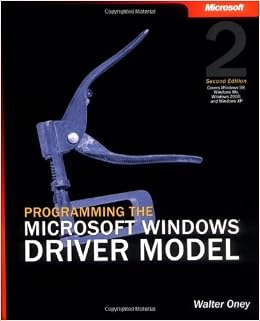
Programming the Microsoft Windows Driver Model (2nd Edition) (Developer Reference)

Download PDF Programming the Microsoft Windows Driver Model (2nd Edition) (Developer Reference)
Being a better individual often likely is hard to do. Additionally, changing the old routine with the brand-new habit is hard. In fact, you may not have to change instantly the old habit to talking. Hanging around, or juts gossiping. You will need step by step activity. Furthermore, the means you will certainly change your practice is by the reading behavior. It will make so difficult challenge to resolve.
Keep your way to be below as well as read this resource finished. You can enjoy searching guide Programming The Microsoft Windows Driver Model (2nd Edition) (Developer Reference) that you really describe get. Here, getting the soft documents of the book Programming The Microsoft Windows Driver Model (2nd Edition) (Developer Reference) can be done quickly by downloading and install in the link web page that we supply below. Certainly, the Programming The Microsoft Windows Driver Model (2nd Edition) (Developer Reference) will be your own earlier. It's no need to wait for guide Programming The Microsoft Windows Driver Model (2nd Edition) (Developer Reference) to receive some days later after acquiring. It's no have to go outside under the heats up at center day to go to guide shop.
We offer Programming The Microsoft Windows Driver Model (2nd Edition) (Developer Reference) that is created for answering your inquiries for this moment. This advised book can be the factor of you to lays spare little time in the evening or in your workplace. Yet, it will not disrupt your works or tasks, naturally. Managing the moment to not just get and read guide is really simple. You could only need couple of times in a day to end up a web page to some pages for this Programming The Microsoft Windows Driver Model (2nd Edition) (Developer Reference) It will not cost so difficult to after that end up guide up until completion.
When you have decided that this is likewise your much-loved publication, you need to check as well as obtain Programming The Microsoft Windows Driver Model (2nd Edition) (Developer Reference) earlier. Be the to start with people and also accompany them to take pleasure in the details related about. To obtain more recommendation, we will reveal you the link to obtain and also download the book. Even Programming The Microsoft Windows Driver Model (2nd Edition) (Developer Reference) that we serve in this site is sort of soft file publication; it does not suggest that the web content will be lowered. It's still to be the one that will certainly motivate you.
About the Author
Walter Oney has 35 years of experience in systems-level programming and has been teaching Windows device driver classes for 10 years. He was a contributing editor to Microsoft Systems Journal and is a Microsoft MVP. He has written several books, including Systems Programming for Windows 95 and the first edition of Programming the Microsoft Windows Driver Model. In his free time he's a committed jogger, a fan of classical dance, and an amateur oboist. He and his wife, Marty, live in Boston, Massachusetts.
Read more
Product details
Series: Developer Reference
Paperback: 880 pages
Publisher: Microsoft Press; 2nd edition (December 26, 2002)
Language: English
ISBN-10: 0735618038
ISBN-13: 978-0735618039
Product Dimensions:
7.4 x 1.6 x 9 inches
Shipping Weight: 2.8 pounds
Average Customer Review:
3.5 out of 5 stars
14 customer reviews
Amazon Best Sellers Rank:
#386,452 in Books (See Top 100 in Books)
It's now 12 years since this book (2nd edition) was released, but it's still a very relevant, useful and helpful resource. Yes, it's about a highly technical topic, so not for beginners. But for readers who already have some background in application development, familiarity with C and C++ and so on, it contains some of the best explanations of the Windows Driver Model which continues to form the basis for Windows device drivers to this day.There are a number of other references for this territory, such as MSDN, the Windows Internals books, and the DDK itself, but what I especially like about Oney's book is the deliberate way he sets out the material, at many junctures anticipating the extra things you need to know for each piece to make sense, often dispelling some doubt or ambiguity that otherwise makes understanding difficult.To be sure, a developer will also want to be familiar with more recent developments that make driver development easier, notably the Windows Driver Framework (fromerly "Foundation") (WDF, KMDF, UMDF). So developers may well not build drivers from scratch as in this book. But drivers built with WDF still must operate within the WDM, so knowing how WDM works is an essential foundation.As for the several less-glowing reviews, note that almost all are from before the second edition was released, so don't actually apply to this edition. This is a sizable tome, with a lot of technical detail, so it's not a surprise that a couple of iterations made for a better result.At this point in time, you may be tempted to purchase a used copy. That's a good investment, but be aware that the accompanying CD, which contains useful tools and sample code, may be missing, and I've not been able to locate an online source for them. The author's original programming site is no longer online.Update: Apparently some aspects of this book were acquired by oreilly, and the supporting material can be located by searching for that name in conjunction with 9780735618039. For what it's worth, the revealing DevView.exe tool does work on XP. However, I found that it is unable to load its crucial DevView.sys driver on Win 7-64, not even with boot-time F8 -- Disable Driver Signature Enforcement, hence not usable on that OS (though it might work on Win7-32). Obviously in some cases one can learn what one needs to know on XP, so still useful.Further update: OSR Online publishes a free utility called DeviceTree, which covers much of the same territory as Oney's DevView, making it a good companion for this book.
If you are writing Windows Device Drivers, this is one of 3 books you absolutely must have. Buy it.
I am borrowing a copy of this book at work, and I agree with the other reviewers that its helpful, and it doesnt "talk down"But it can get quite rambly, the IO Request Chapter is a great example of this.That being said I actually tried to include his DEVQUEUE in my driver code im using at work...Ive been programming for 10+ years so im not a slouch.Problems:1) C code written using C++ rules. This is annoying.2) Doesn't compile at tighter warning levels...LOTS of warnings3) Bug in DEVQUEUE initialization sent me on an IRP goosechase for good part of a day, and YES I did download his code service packs first. Watch out for stallcount being initialized to 1, StartNextPacket will refuse to run unless you change this to zero.
Is one of several *essential* books for WDM Programming. Also see Chris Cant's book. Walter's is a bit more detailed, Chris's more approachable. You need both.This is an extremely difficult topic, and Walter does a good job of making it understandable.USB Chapter is also quite good.
Walter Oney is an expert who doesn't talk down to you. There's a lot of gold in this well-written book, but to extract it happily you'll need a strong background in Windows programming, including first and foremost a couple of years of professional driver-writing experience for Win9X/NT platforms; in a few places, some knowledge of COM and MFC will also be helpful. Plug and Play, power management, and USB issues are covered in detail, as well as driver basics (from an advanced perspective), the intricacies of cancelling IRPs, etc.I like Oney's approach to teaching -- he concentrates on the logic of the few dozen basic steps needed to write a driver, leaving it to the samples on the accompanying CD to flesh out the skeleton. This has the advantage of highlighting the mechanics, and the often convoluted reasoning behind them, without sacrificing completeness. He identifies and analyzes many potential race conditions and other pitfalls that you might not think of on your own.One of the best things about the book is the tips and sidebars. Some examples: why you should use the PAGED_CODE macro and Driver Verifier when using Soft-Ice/W on Win2k; the hazards of using DDK "function calls" that are actually macros; how to ship a single binary for both Win2000 and Win98, given that Win98 doesn't support some key functions (such as those involving IO_REMOVE_LOCK) -- the book suggests writing a VDD with stubs for the missing functions, as explained in Appendix A. The sample code also contains very instructive workarounds for the shortcomings of Win98. Another strong point is the DEVQUEUE code that Oney has developed to extend the standard Windows driver model to handle PlugandPlay. In addition to including the code on the CD, he gives a detailed and highly instructive discussion in the text. DEVQUEUE is a useful tool that can be taken over as-is in your own projects.Once you've finished this book, you'll be writing much more solid code and have enough technique to pick and choose among methods of your choice, rather than feeling cornered and boxed-in. Oney maintains a web site with errata and updates for the book and code samples (for instance, the stub VDD is now replaced by a filter driver to avoid the need to reboot).
If you're developing device drivers for a Windows operating system then this book is a must. I think this book is well organized and includes important information regarding all the aspects of developing Windows drivers. I also think that the book misses information on important web sites that can help developers.
If you are writing Windows Device Drivers, this is one of 3 books you absolutely must have. Buy it.
Programming the Microsoft Windows Driver Model (2nd Edition) (Developer Reference) PDF
Programming the Microsoft Windows Driver Model (2nd Edition) (Developer Reference) EPub
Programming the Microsoft Windows Driver Model (2nd Edition) (Developer Reference) Doc
Programming the Microsoft Windows Driver Model (2nd Edition) (Developer Reference) iBooks
Programming the Microsoft Windows Driver Model (2nd Edition) (Developer Reference) rtf
Programming the Microsoft Windows Driver Model (2nd Edition) (Developer Reference) Mobipocket
Programming the Microsoft Windows Driver Model (2nd Edition) (Developer Reference) Kindle


0 komentar:
Posting Komentar